






High-Speed FFC Cables for LVDS and High-Frequency Transmission
Data rates keep climbing in automotive displays, consumer video, and industrial vision, and flexible flat cable has had to follow. A modern FFC cable is no longer only a cheap, thin substitute for round wire; it is specified for high-frequency transmission while keeping the bend radius and stack height that mechanical designers already assumed. That dual requirement — speed plus flex — is reshaping materials, pair layout, and shielding.
A central development is high-speed FFC for low-voltage differential signaling (LVDS). These constructions can deliver 2 to 10 gigabits per second in the same compact, flexible form factor as a conventional FFC. That range covers many automotive display links and high-resolution video runs where the cable must hold signal integrity over a longer path than a board-to-board mezzanine allows. Length, fold count, and connector family then become electrical variables, not just packaging details.
Differential pairs inside the FFC improve signal integrity by cutting electromagnetic interference and crosstalk relative to single-ended neighbours. Modern LVDS FFC jumpers use that layout to support high-speed USB connections from 2 Gbps to 10 Gbps, and they are used on digital interfaces including DisplayPort and V-by-One HS. In noise-sensitive environments — large displays, 4K and 8K televisions, camera hubs — the pair geometry and a defined ground reference matter as much as conductor thickness.
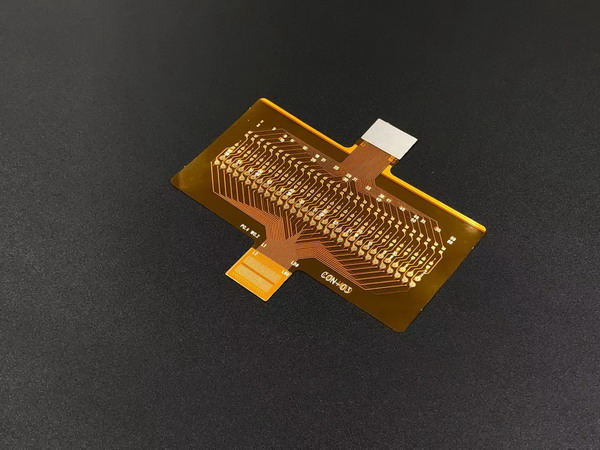
Engineers are treating FFC ribbon as a serious option in high-frequency environments because the geometry is predictable. A flat, parallel conductor array has a more stable impedance window than a dressed round bundle, provided the dielectric, pitch, and fold rules are controlled. Well-designed FFC holds characteristic impedance along the length, which is what high-speed receivers need. ZIF and LIF FPC connectors with matching pad geometry complete the channel; a mismatch at the tail is a common source of return loss.
Product roadmaps also point to higher temperature and humidity resistance and stronger EMI shielding, not only higher bit rate. Server and AI terminal equipment ask for operational stability under load, where a poorly shielded flex can radiate or pick up switching noise. Foil, mesh, and absorber stacks are being designed into FFC rather than added as an aftermarket wrap. As data-center and edge architectures pack more I/O into smaller boxes, those shielded high-speed FFC SKUs move from specials into standard RFQs.
Materials do as much work as layout. Newer dielectric formulations and conductor treatments improve insertion loss and thermal tolerance; automated assembly and inline inspection raise yield and cut unit-to-unit variation in impedance. For design engineers, the limitation is still physics: too many folds, too small a bend radius, or an unshielded run next to a DC-DC converter will undo a careful pair design. High-speed FFC succeeds when electrical and mechanical constraints are written into one drawing.
Selecting a high-speed FFC therefore starts with the interface (LVDS, USB, DisplayPort, V-by-One HS), the required Gbps, the maximum length, and the EMC environment. Pitch, pair assignment, plating, and whether the tail is gold for a ZIF connector should be frozen with the first layout, not after EMC failure. Custom FFC is often cheaper than iterating a catalogue part that was never meant for that frequency.
Nurwire manufactures high-speed custom FFC cable under ISO 9001:2015, with RoHS and REACH-compliant materials, optional EMI shielding, and differential-pair layouts for LVDS and similar links. If your next display, camera, or industrial vision channel needs a flexible flat cable that holds 2–10 Gbps, we can match pitch, shielding, and ZIF tails to the connector you already tooled.